While I was eating my Kodiak Protein Pancakes this morning, I was bothered by this thought:
Wow this tastes good... wait, how do I know it tastes good? How do I know I actually like it?
At first, it seems an odd question to consider. Surely we know what food we enjoy, right? I mean we put food in our mouths, toss it around our teeth, mix it with our salvila, swallow it, and then a voice in our heads confirms we are either enjoying or not enjoying the taste of that food.
Considering the pancakes I was eating this morning, in all honesty, the average person would probably throw them away. The taste of the Kodiak Pancakes would simply be too unpleasurable for their taste buds to enjoy. Yet I enjoyed them, I think. Moreover, I'm aware a traditional pancake with syrup would send me to food heaven, but I'm still content with my dry ass wheat protein circles trying to imitate a pancake.
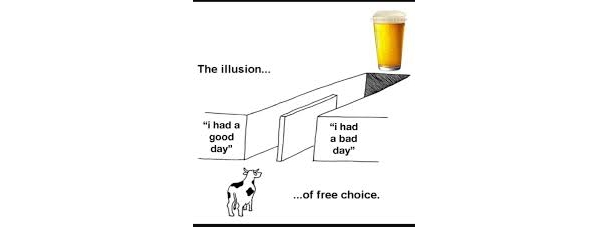
How can this be? I didn't decide whether or not to like the healthy pancake. And clearly the hundreds of millions of obese people haven't decided to enjoy the taste of them either. Our "choice" of whether or not we enjoy a particular food is entirely decided by deterministic biological processes: chemicals binding to receptors, neurons firing, and the brain interpreting these signals. You don't consciously decide that sugar tastes sweet; that's hardwired into your biology. Similarly, your cravings for fats and sugars (or rather junk food) aren't freely chosen but are evolutionary adaptations.
In another analogy that may better illustrate this point, consider GLP-1 weight loss drugs. Many users of these medications report that their previous cravings for junk foods completely diminish. Even more remarkably, people have reported they've entirely stopped smoking or drinking alcohol while taking these drugs. These changes weren't the result of the users' "free will" deciding to stop craving junk food, cigarettes, and alcohol, but rather the result of the drug directly modifying the brain's reward mechanisms.
The truth is that we don't consciously decide what tastes good nor what addictions we'll pick up. No one would choose to be overweight or an addict if these were truly voluntary decisions. Everything about us that feels like a unique individual choice simply results from unconscious biological processes driving our behavior.
I fully admit this isn't particularly the best argument against the illusion of free will. My favorite, and strongest argument, is an analysis of how thoughts truly occur and our relationship to them. But I'll save that for another essay. For now, I'd encourage you to question everything you do today. Why did you pick those particular clothes, why did you eat that for lunch, why listen to that particular albumn? And when you think you know why—remember that your brain is remarkably good at creating explanations for decisions it never actually made.