
Don't Go to College
College in the United States has long been perceived as the ultimate investment of time and money, promising greater earning potential and career advancement. However, as artificial intelligence prepares to automate vast portions of value-creating labor, what genuine value does a college degree still hold? Arguably, very little. Unless your ambition lies in contributing to academia within a highly specialized niche, save your time and money. Don't go to college.
Over the years, data has consistently shown that U.S. college graduates typically earn substantially more over their lifetimes compared to those without degrees. This correlation has fostered the belief that higher education guarantees higher income. While maybe historically accurate, this assumption collapses in a society which is about to experience an existential crisis.
By graduation, AI already has your degree.
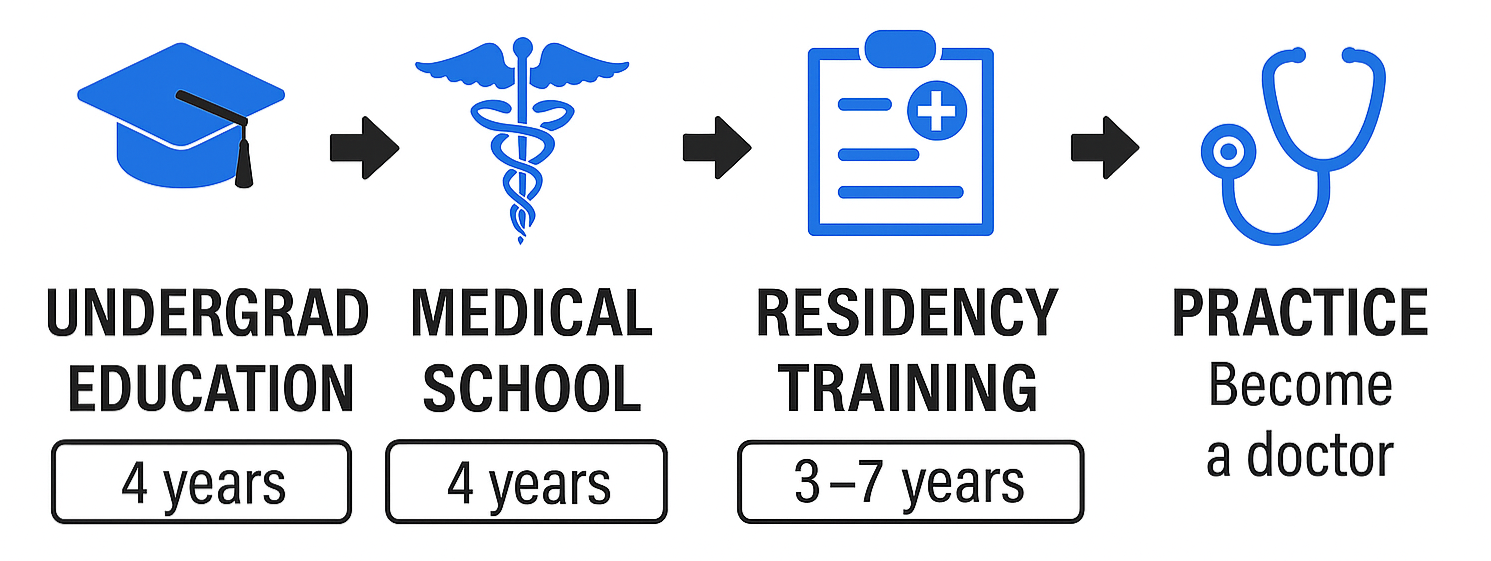
To prove my claim, let's analyze the timeline for becoming a doctor—arguably the most highly valued profession in society. On average, it takes between 10 and 14 years to become a practicing physician. And let's not forget the crippling debt you'll accrue: the median four-year cost of public medical school is $268,476.
Now consider the pace of artificial intelligence. The initial public release of ChatGPT occurred in early 2023. In just two short years, by 2025, we've already seen incredible leaps forward. The newest models, like GPT-o3, make the original ChatGPT seem almost primitive. This is not even to mention that Gemini's models (2.5 pro) are even better. What improvements will be made by next year? What about in five more years, or in a decade?
Now consider this thought experiment:
You have a child in 11th grade whose dream is to be a doctor. As a good parent should, you're discussing with them their academic performance, college options, and future steps forward (how thrilling).
Given the rapid advancement of AI, does it really seem rational to commit them to over a decade of schooling and a Lamborghini's worth of debt? Fast forward 12 years to 2037: it's certain that by then, robots and medical AI systems will handle routine checkups, prescribe medications, offer precise health recommendations, and even perform surgeries. Is investing in a traditional medical education still the smart choice?
I'm not talking out of my ass I promise:
- World's first AI+ robotic remote throat surgery completed in China's Xinjiang
- New AI Research Foreshadows Autonomous Robotic Surgery
- AI-Powered Robotic Surgery: Pushing The Boundaries Of Minimally Invasive Procedures
Yes engineers, we too are also f*cked.
I hope I gave you something to think about in this short post.
As I have often mentioned before, people still don't seem to grasp the sleeping dragon that is AI. Everyone has their fun asking GPT to do their linear algebra homework, then we move on with our day. But the up and coming singularity isn't about LLM's doing our mundane busy work. It's about integrating trained AI models into medicine R&D, drug discovery, finance, etc. It's about creating robots which will replace factory workers, your Starbucks barista, farmers, etc. And finally, it's about freeing up human potential—so we can spend less time surviving, and more time creating, connecting, and caring for one another.
Now perhaps using a doctor as the example was too extreme. Maybe I should have mentioned engineers, lawyers, or software developers. But the point still remains: if the doctors jobs aren't safe, what makes you think yours is?